Blog
Repair vs Replace a Marine Fuel Tank | DolFab
A practical guide to deciding whether a marine fuel tank should be repaired or replaced, with inspection, safety and USCG checkpoints from DolFab in Fort Lauderdale.
A leaking or corroded marine fuel tank creates a decision that should be based on evidence, not guesswork. The right path depends on the tank material, leak location, corrosion extent, accessibility, age, and the requirements that apply to the vessel. A qualified marine fabricator should inspect the tank and surrounding structure before anyone commits to a repair or replacement.
The short answer
Repair can make sense when damage is localized, accessible, and surrounded by sound material. Replacement is usually safer and more predictable when corrosion is widespread, the tank has repeated leaks, the material or history is unknown, the damage is inaccessible, or the existing tank no longer fits the vessel's requirements.
A quick patch may stop a symptom while leaving thin metal, failed supports, damaged baffles, or a compromised fitting in service. A replacement may cost more up front but can resolve access, geometry, inspection, and installation issues as one defined scope.
Start with a proper inspection
Fuel-system work requires qualified professionals and appropriate fire and fume controls. Before inspection, the tank and work area must be handled with safe isolation, draining, cleaning, and ventilation procedures appropriate to the vessel and fuel system. Do not cut, grind, weld, or pressure-test a fuel tank that has not been properly prepared.
A useful inspection records:
- The exact leak location, fuel odor, staining, and operating symptoms.
- Seams, baffles, fittings, supports, drains, vents, and the tank bottom.
- Material, alloy, thickness, weld condition, distortion, and evidence of pitting.
- The compartment, bedding, straps, nearby dissimilar metals, and access path.
- Whether the tank can be removed intact and whether surrounding structure is sound.
When repair may be appropriate
Repair may be reasonable when the problem is a localized pinhole or seam issue and the surrounding metal remains structurally sound. The damaged area must be accessible for proper preparation and welding, without creating a new hazard or leaving hidden corrosion in place.
A repair plan is more defensible when the affected area is defined and accessible; there is no widespread pitting, cracking, distortion, or repeated leakage; fittings, baffles, bedding, and supports can be restored; and the repair can be inspected, tested, and documented after completion.
When replacement is usually the better choice
Replacement is commonly the better path for extensive pitting or corrosion, multiple leaks, a thin or distorted shell, failed baffles or fittings, contamination, or a tank that cannot be safely accessed. It is also worth considering when the alloy, thickness, construction history, or prior repairs cannot be verified.
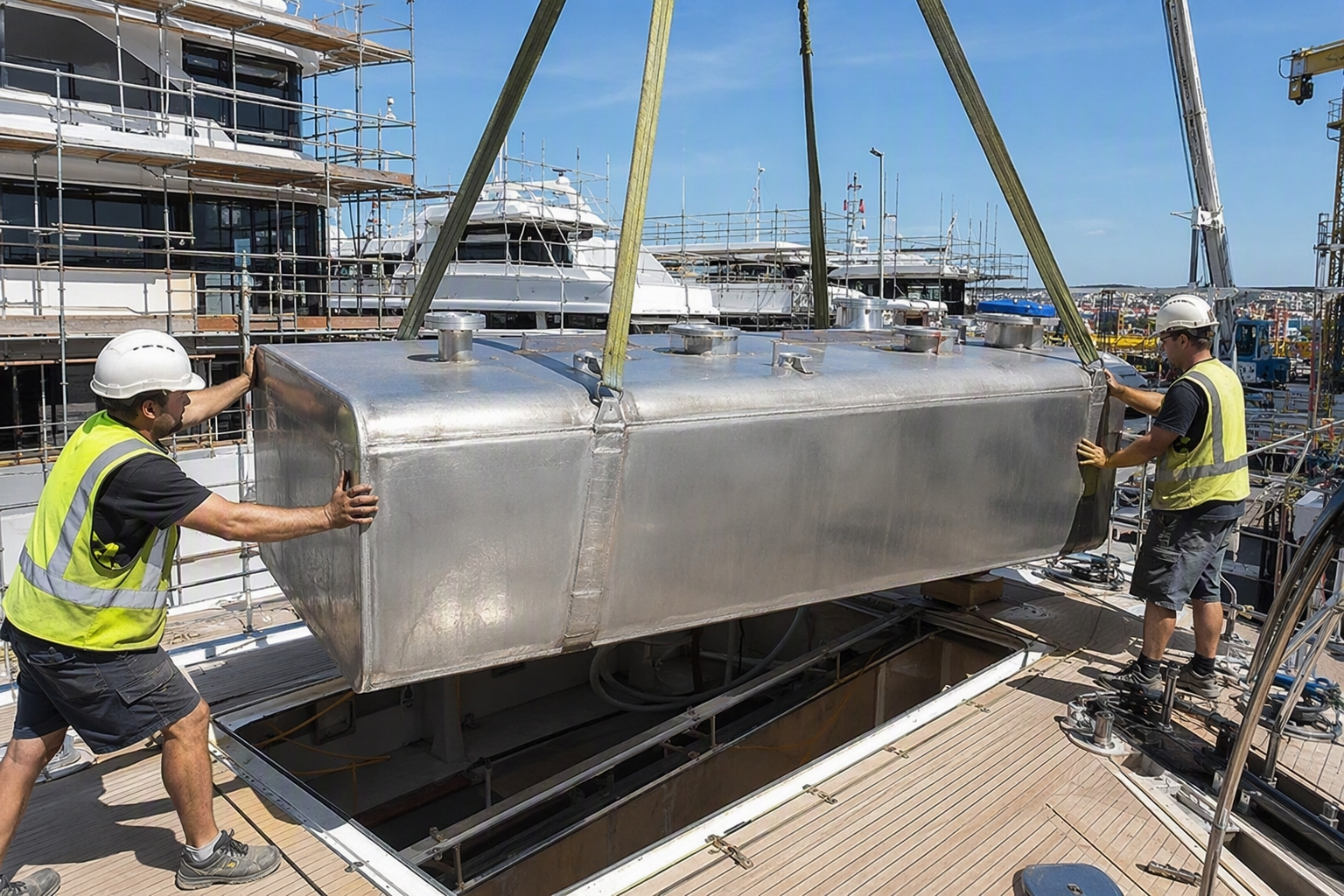
A replacement gives the fabricator an opportunity to address recurring problems, improve access for future inspection, update the layout, and match the tank to the actual compartment envelope. If the tank has already required repeated repairs, compare the cost and downtime of another patch with a defined replacement scope.
Why tank material and construction matter
Marine tanks are not interchangeable boxes. Alloy compatibility, thickness, weld quality, baffle arrangement, supports, vent and fill fittings, and isolation from dissimilar metals all affect service life. The right material and thickness depend on the fuel system, vessel design, installation details, applicable requirements, and the fabricator's qualified procedures.
Do not specify a one-size-fits-all alloy or thickness from an online checklist. The inspection should verify what is present, and the replacement design should document what is being built and why.
USCG requirements: use them as a design checkpoint
USCG requirements are the relevant checkpoints when reviewing fuel systems, tanks, and installation details. The current editions, the vessel's design, and the applicable authority requirements must be reviewed by the qualified professional responsible for the work. A general article cannot approve a vessel or replace an inspection.
Use the review to confirm tank arrangement, fittings, venting, supports, access, bonding or isolation details, and testing expectations. Keep the applicable edition and project-specific decisions in the vessel's documentation package.
How DolFab helps
DolFab is a Fort Lauderdale marine fabrication shop that can evaluate a repair-versus-replace decision, coordinate measurements and access, and fabricate a custom marine aluminum tank to the existing compartment envelope. Shop work provides controlled fit-up, fabrication, finishing, and testing; vessel-side coordination can be arranged when the project requires practical access planning.
See custom marine fuel tank fabrication for the tank scope, materials, baffling, and pressure-testing approach. DolFab uses the exact certification language: ABS-certified welding and USCG-compliant marine fabrication. The final scope remains vessel-specific and subject to the applicable review and inspection process.
Questions to ask before choosing
Before approval, ask what material, alloy, thickness, and construction details were verified; whether corrosion is localized; whether the tank and surrounding structure can be accessed; what testing and documentation will be provided; whether removal requires structural access cuts; how bedding, supports, fittings, and dissimilar-metal interfaces will be addressed; which current requirements apply; and what inspection access will remain.
Decision checklist
A repair is more likely to fit when:
- Damage is localized and the surrounding material is sound.
- The tank is accessible and its material and history are known.
- Baffles, fittings, and supports remain serviceable.
- The repair can be safely prepared, welded, inspected, and tested.
Replacement deserves priority when:
- Pitting, corrosion, distortion, or leaks are widespread or recurring.
- The tank's alloy, thickness, or construction history is unknown.
- The tank cannot be safely accessed or removed for thorough inspection.
- Baffles, supports, fittings, or the compartment arrangement need redesign.
- A new tank can improve fit, access, documentation, and predictability.
Frequently asked questions
Is it safe to patch a leaking marine fuel tank?
Not without proper isolation, cleaning, ventilation, and qualified oversight. A patch may be appropriate only after inspection confirms localized damage and sound surrounding metal. Fuel-system work should not be improvised aboard a vessel.
How long does a marine fuel tank replacement take?
Timing depends on access, removal, measurements, design review, material availability, fabrication, testing, and installation. Photos, dimensions, drawings, and the vessel's schedule help define a realistic sequence.
Can you repair a tank in place?
Sometimes, but only after the tank and work area are assessed for safe access, preparation, ventilation, fire control, and post-work inspection. Shop removal may provide better control and more predictable testing.
What helps DolFab prepare a quote?
Send the vessel location, tank type, material if known, dimensions or drawings, leak or corrosion photos, access constraints, desired schedule, and any applicable requirements. Do not remove fittings or open a tank solely to create quote information.
See DolFab's project work
Project examples and fabrication capabilities are collected on the Projects page. A separate fuel-tank case-study URL is not published in the current project, so this guide links to the hub rather than creating a broken case-study link.
Talk with a marine tank specialist
Send the inspection details to DolFab for a practical repair-versus-replace discussion. Call 866-365-3221 Monday-Friday 8-5, or request a quote through the site. DolFab is at 6800 NW 15th Way, Fort Lauderdale, FL 33309. Learn more at www.dolfab.com.
Fuel tank decisions are vessel-specific. Never work on a tank without proper isolation, ventilation, and qualified oversight.
Tell us what you need built.
Send the material, size envelope and the date it has to be aboard. You will be talking to the shop that cuts, welds, finishes and installs the part.